New normal: reaching the new normality after Covid – how does it work?
The New Normal.
Since corona turned the world upside down, this term has been omnipresent. Politicians, news anchors, economic analysts and many more speak almost daily about the New Normal.
But what is actually meant by it and why don't we simply return to the familiar everyday life? In this article, you'll learn what New Normal is all about and to what extent your organization is affected by it and can gain a competitive advantage through fast adaptation.
Is New Normal really new?
The term New Normal has been our faithful companion since the first half of 2020. But even if it seems that way, the concept itself isn't new.
In the Anglo-Saxon world, the idea of New Normal has been known for some time. The description is used for that state which prevails after a drastic crisis.
By it we mean new economic, social and political conditions. These differ fundamentally from the circumstances before the turning point and have such a great influence that they'll also shape the time afterward in the long run.
So US media, for example, already spoke of a New Normal when processing the financial crisis in 2008.
In the German-speaking world, the term New Normal has been strongly shaped since 2018 by the publications of the Austrian philosopher of language Paul Sailer-Wlasits and the philosopher Hans Martin Esser. But its great fame as a political catchphrase and ominous future forecast came with the Covid pandemic.
Covid as a Black Swan event?
Have you ever fed swans at an idyllic pond? How often did a black swan appear in the process? Probably rather rarely.
That's exactly the basis of the Black Swan theory. It comes from the author Nassim Nicholas Taleb and refers to events that…
- …occur completely unexpectedly;
- …although unlikely, definitely lie within the realm of the possible;
- …when they occur, have a great impact;
- …entail profound consequences;
- …aren't always completely understood by people or, in hindsight, not completely processed.
Covid-19 is titled by many as such a Black Swan event, even if this classification isn't entirely correct.
Whether a Black Swan event or not: Covid-19 has changed our everyday life enormously.
Since the first cases of SARS-CoV-2 officially appeared at the end of November 2019 in the Chinese city of Wuhan, our lives have changed fundamentally. Over the course of the past and current year, many millions of people were infected with the virus. Worldwide, governments faced the challenge of protecting their populations from a threat that was unknown until then. Borders were closed, curfews imposed, safety and hygiene measures were suddenly as important as never before.
That had – and has – dramatic effects. Because a little more than a year after the outbreak, one thing is certain. The coronavirus won't leave as quickly as it came.
Quite the opposite – even without a look into the crystal ball, it's clear that the consequences of the pandemic will occupy us for many more years. A return to the status quo before Covid is ruled out.
Be it on a medical level, which deals with researching and sustainably fighting the virus. Or on a political and social level, in that a way of dealing with the changed conditions for coexistence has to be defined. And not least, the focus is also directed at the economy.
A New Normal is announcing itself.
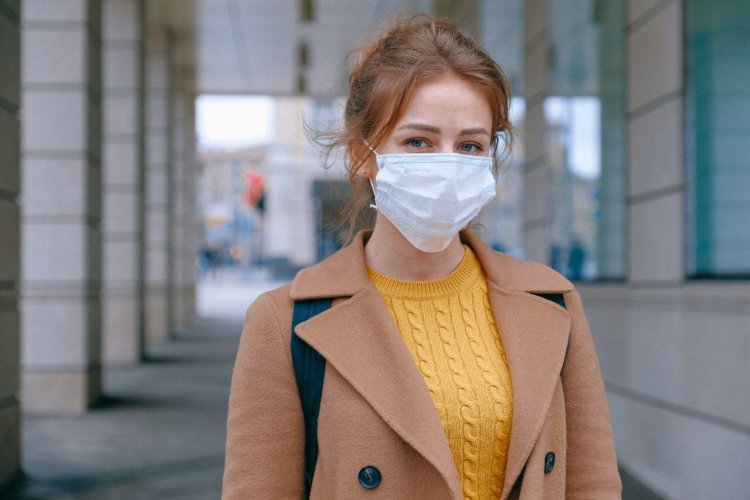
Not only the mask quickly became the New Normal.
Does a dark future lie ahead for German companies and organizations?
The corona crisis and its consequences can already be felt in all industries. No wonder, because companies and organizations in Germany were confronted at the start of 2020, within the shortest time, with numerous challenges.
The majority of them continue, such as:
- New legal requirements that concern and affect day-to-day business;
- The shift of processes into the digital space and the introduction of mobile working, to stay capable of doing business despite the restrictions;
- Supply shortages of raw materials and goods, especially from other countries, due to tougher entry and import regulations;
- Restrictions on the export of products manufactured in Germany;
- A changed consumption behavior of consumers due to curfews and increased financial uncertainty;
- Lower profit margins or, in some sectors, even the complete loss of the business basis.
These and many other factors contributed to the German gross domestic product, among other things, falling by 5% in 2020. The federal government does counteract this effect with aid worth many hundreds of billions and the promotion of short-time work. Nevertheless, the Covid pandemic represents a turning point whose end isn't yet foreseeable.
According to the current state, experts assume that the virus becoming endemic is quite possible. A worldwide immunization with the help of vaccines is only hesitantly underway and without reliable future forecasts. Not to mention the recession from the weeks-long near-standstill of the entire economy.
For German organizations, this brings above all one consequence: only those who adapt as well as possible to this New Normal with the virus have a competitive future.
But what does it actually take for that?
How organizations (ex)perience the New Normal
Briefly summarized: changed conditions require new solution approaches.
In the course of the above-mentioned challenges, many organizations were forced in recent months to radically switch their structures and processes. One of the biggest impulses was the rapid acceleration of digitalization.
For most companies, digitalization represented a kind of life vest to keep business processes running despite curfews, fear of infection as well as closed shops and venues.
In practice, this led to the ad-hoc implementation of measures that previously, in many businesses, were known only from theoretical debates about New Work:
- Organizations whose business area allowed it relied on letting their employees work from the home office;
- Hybrid constellations of virtual and on-site teams arose and increasingly solidified;
- Working-time concepts like the proven nine-to-five week blurred through the new flexibility of working from home;
- Communication, internal processes, daily tasks and organizational questions were digitalized.
The digital and flexible execution of one's own work is, for many, a big part of the New Normal.
Similar to the initial challenges of the corona crisis, these effects too have continued for more than a year now. That brings two insights with it:
1.) Increasing digitalization in the sense of New Work works in application and will continue to occupy us in the future.
2.) This switch requires a long-term rethink from organizations.
Working in the pandemic is not a short-term state of emergency that simply has to be mastered. There will be no „afterward“ that's like the „before“. Rather, the New Normal is long since lived reality for German companies. So it takes innovative and, above all, sustainable strategies for completely new challenges.
Hundreds of thousands have come to know working from the home office and now have a direct comparison to their previous situation, which awakens new wishes. Virtual teams that arose require innovative management and efficient workflows. On top of that comes the ongoing instability of the market, which increases the relevance of flexible and agile company leadership. And those are just some examples of how the New Normal will influence you and your organization too.
Admittedly, that sounds very complex and managing it is anything but easy. But we assure you: this transformation process of the economy and the working world offers your organization many opportunities.
New Normal? Better Normal!
Whether the New Normal is advantageous or disadvantageous for a company is ultimately a question of perspective.
At this point it can be helpful to draw on support from external partners with appropriate expertise. They can make a neutral assessment of existing and future potential and thus create valuable solution approaches for the realignment of your business model.
With BETTER NORMAL, grandega offers such a concept for managing complex pandemic requirements. Our experiences of recent months showed an interplay of eight primary solution building blocks, which are individually adapted for your organization and, if necessary, extended or reduced:
1) Upskilling – Virtual working requires new knowledge and competencies from employees and leaders. Digital knowledge building and an understanding of new technologies are essential to avoid skills gaps.
2) Mix virtual & onsite concepts – Fixed workplaces and shift systems are increasingly dissolving. Hybrid or even completely virtual teams need a work environment tailored to their needs. Conceivable, for example, is a combination of home office and the workplace on site.
3) Virtual project management – To ensure your workforce's productivity online, you need appropriate structures, tools and workflows. Aspects like communication and responsibilities have to be reorganized.
4) Digital leadership – Your leaders help you successfully implement digital change in your organization. All the more important is their training as well as the comprehensive further development from a classic to an agile leadership concept.
5) Collaboration – With digitalization comes the need for a stronger internal and external networking of your organization. But for collaborative working to really work, communicative barriers first have to be removed and new values created.
6) Cultural change – Increasing flexibility and digitalization bring a redefinition of existing cultural values. Topics like work-life balance, a sense of purpose, equal opportunities and trust are put in a different light.
7) Reorganization – Your existing business model is assessed and realigned based on economic, social and ecological aspects. This sustainably increases your customer focus, competitiveness and resilience.
8) Smart cost management – A strategy tailored to you for proactive cost management helps you secure your position even in a volatile market. This happens, among other things, through identifying weak points and savings opportunities in your cost structure.
The grandega BETTER NORMAL approach unites eight solution building blocks that, individually or combined, help ensure you remain competitive in the future too.
The combination of these measures enables you not only to come through the effects of the corona crisis resiliently and future-proof. In addition, you benefit from a holistic transformation that arms your organization for the successes of tomorrow.
It should be emphasized that we don't mean economic value alone. Rather, it's about using the New Normal as an opportunity for you, your employees and also your customers, to shape it into a BETTER NORMAL.
If you'd like to learn more about how you can not only maintain but improve the value creation of your organization, then contact us.